
OEM Jewelry Development: Fees, Files and Approvals
Three questions decide whether an OEM development runs smoothly: what files you hand over, when the cost structure gets set, and who signs off at each gate. The published schedule gives you the answer to the timing — CAD back within from CAD at sampling at CAD back within CAD CAD 48 hours, sample 25–30 days, run 3–4 weeks for production — and the cost structure is settled during consultation, before any tooling exists.

Key takeaways
- Feasibility, material selection and cost structure are settled at consultation, before CAD begins.
- The CAD stage is published at under 48 hours and is the first approval gate you own.
- Sampling at 25–30 days and production at 3–4 weeks make up roughly 96% of the published schedule.
- Minimums are 100+ pieces in the stainless line, 100 in the eco-brass line and 50 pieces in sterling silver, per design, which means a two-design range starts at twice those numbers.
The files that actually start a project
Inquiry accepts four kinds of input: a sketch, reference photos, an existing sample piece or a tech pack. You do not need a finished CAD file — the modelling is part of the service and comes back in under 48 hours with dimensional drawings and renderings for approval.
What the file does need is enough information to be priced. A reference photo says what the piece should look like; it does not say what it is made of, how it is plated, or what happens to the back of it. Sending a photo and three sentences about material and finish is faster than sending a perfect drawing of the wrong piece.
Where the cost structure is actually set
The published process names consultation and development as its own step, covering feasibility, material selection and cost structure. That is the step where the shape of the budget is decided, long before a price is attached to a specific drawing, and it is the step most brands skip.
It matters because the material choice drives the minimum and the routing. Base materials on offer are artisan brass with recycled content, 316L stainless steel and 925 sterling silver and 100+ for stainless steel. A brand that learns this during consultation prices realistically; one that learns it after sampling is re-planning a season.
Three approval gates, and who owns each
Gate one is dimensional sign-off on the CAD, which is yours and belongs on a screen. Gate two is sample approval after the 25–30 day sampling window, and that one involves your hands as well as your eyes. Gate three is the production run at 3–4 weeks, which is a specification decision rather than a design decision.
Each gate is a stopping point, not a formality. A supplier who pushes for sample approval before you have handled the piece is skipping the only physical check available before the batch.
What a quote should itemise
An itemised quote for custom work names the base material, the plating route, the stone or accent work, the hallmark engraving, the packaging set and the quantity tier it assumes. Those six lines map onto the six published customisation options, and each one is a place where a change later alters the job.
gold in 14K, 18K and 24K, rhodium — and for protection, an anti-tarnish e-coat for silver and brass plus vacuum PVD plating on stainless steel.
The files you should get back
By the end of a first project you should hold the CAD drawings, the renderings, the approved sample specification, the packaging artwork and the per-batch inspection record. Documents stay with the brand under the OEM/ODM arrangement, and designs are covered by 100% NDA, with moulds and CAD files not resold to other buyers.
Ask for those files at the point of approval rather than at the end of the year. Files that exist are easy to hand over; files that have to be reconstructed tend to arrive in a different version than the one that was actually built.
What changes a fee after the quote
Four things, and all four are visible in advance. A design revision after tooling sits inside the sampling window rather than the 48-hour one. A plating change moves the piece between plating routes. A packaging change pulls artwork back from the printer. And a quantity change can drop an order below the per-design minimum for its material.
None of those is a surprise if the specification is written down before gate one. ISO 9001:2015 covers the quality management system that repeats the process; it does not cover the decisions you make about the piece, which is why the specification document is the part of the project you own outright.
| Item | When it appears | Published figure |
|---|---|---|
| Accepted inputs | Inquiry | Sketches, reference photos, tech packs |
| Cost structure | Consultation and development | Feasibility, material selection, cost structure |
| CAD and renderings | After consultation | Under 48 hours |
| Master sample | After CAD approval | 25–30 days |
| Production run | After sample approval | 3–4 weeks |
Worked example: the fee question arrives at hour 48 of hour 1,440
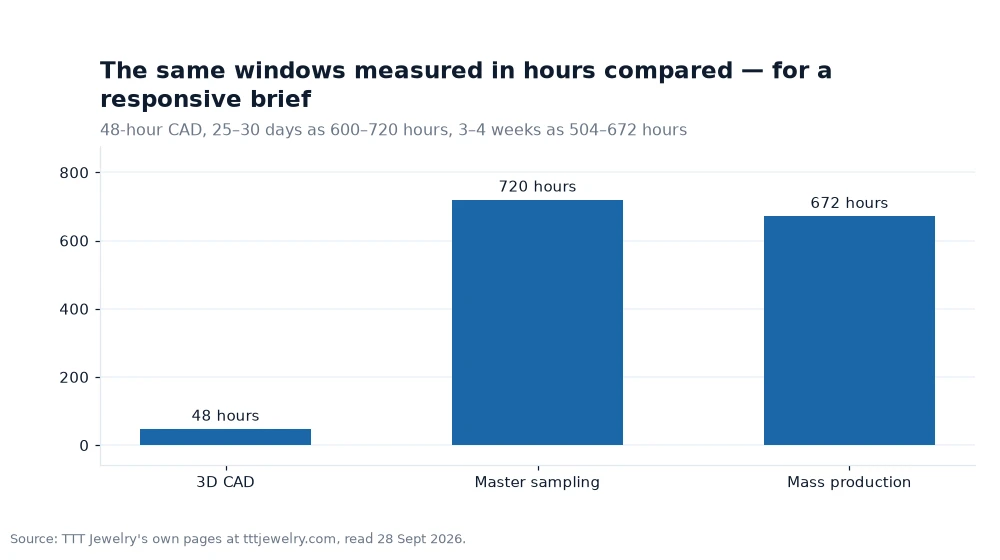
Put the published windows on one clock in hours. CAD is 48 hours. The sampling window of 30 days comes to 30 × 24 = 720 hours, while production over 4 weeks gives 28 × 24 = 672 hours. The slowest full cycle is therefore 48 + 720 + 672 = 1,440 hours, which is 60 days.
Now locate the cost conversation inside that clock. CAD is 48 ÷ 1,440 ≈ 3.3% of the cycle; sampling is 720 ÷ 1,440 = 50%; production is 672 ÷ 1,440 ≈ 46.7%. Half the calendar is a single gate, which is precisely why an unresolved question about material or finish costs so much when it arrives late.
At the fast end of the published windows — 25 days of sampling and 3 weeks of production — the cycle is 48 + 600 + 504 = 1,152 hours, and every proportion stays in the same order. The stage lengths move; the fact that sampling and production own the clock does not.
Frequently asked questions
What should be sent with a first inquiry?
A sketch, reference photos, an existing sample or a tech pack — plus the material, finish, packaging and rough first-run quantity, which decide the tooling route.
When is the development cost structure set?
During consultation and development, which covers feasibility, material selection and cost structure before any CAD work begins.
Who approves each stage?
You do. CAD sign-off, sample approval and the production specification are all buyer-side gates, with written confirmation recommended at each.
Sending a brief that gets priced properly
Write the file list, the finish and the quantity in one message, then let the consultation step price it. Brands that see how the six options and the minimums interact before the quote arrives ask fewer questions later, which is what the view OEM services page is organised around. It is also worth reading the custom jewelry wholesale terms and the workshop tour page before a quantity is fixed.
The published detail behind this piece — the confidentiality terms and the master-sample benchmark — sits on the client's own website on the tttjewelry.com site, dated 28 Sept 2026. Five packaging items and four platings are published, and the reply commitment is 24 hours. Plating runs 14K, 18K or 24K gold or rhodium, with an anti-tarnish e-coat for silver and brass. The hourly and weekly restatements are my own arithmetic — the site supplies the inputs only [1]