
Stability and Shelf-Life Testing Mistakes That Sink a Travel Retail Launch
Stability and shelf-life problems in a travel retail launch almost never announce themselves as test failures. They show up as a colour shift noticed in a warehouse, a sprayer that stiffens after a month in a warm stockroom, or a retailer asking for evidence that nobody can produce quickly. The root causes are consistent: the finished product in its real pack was not the thing tested, the test was shortened to fit a launch date, or the batch that shipped was never compared against the batch that was approved. Each of those is avoidable, and each is cheaper to avoid than to fix once the listing is live.
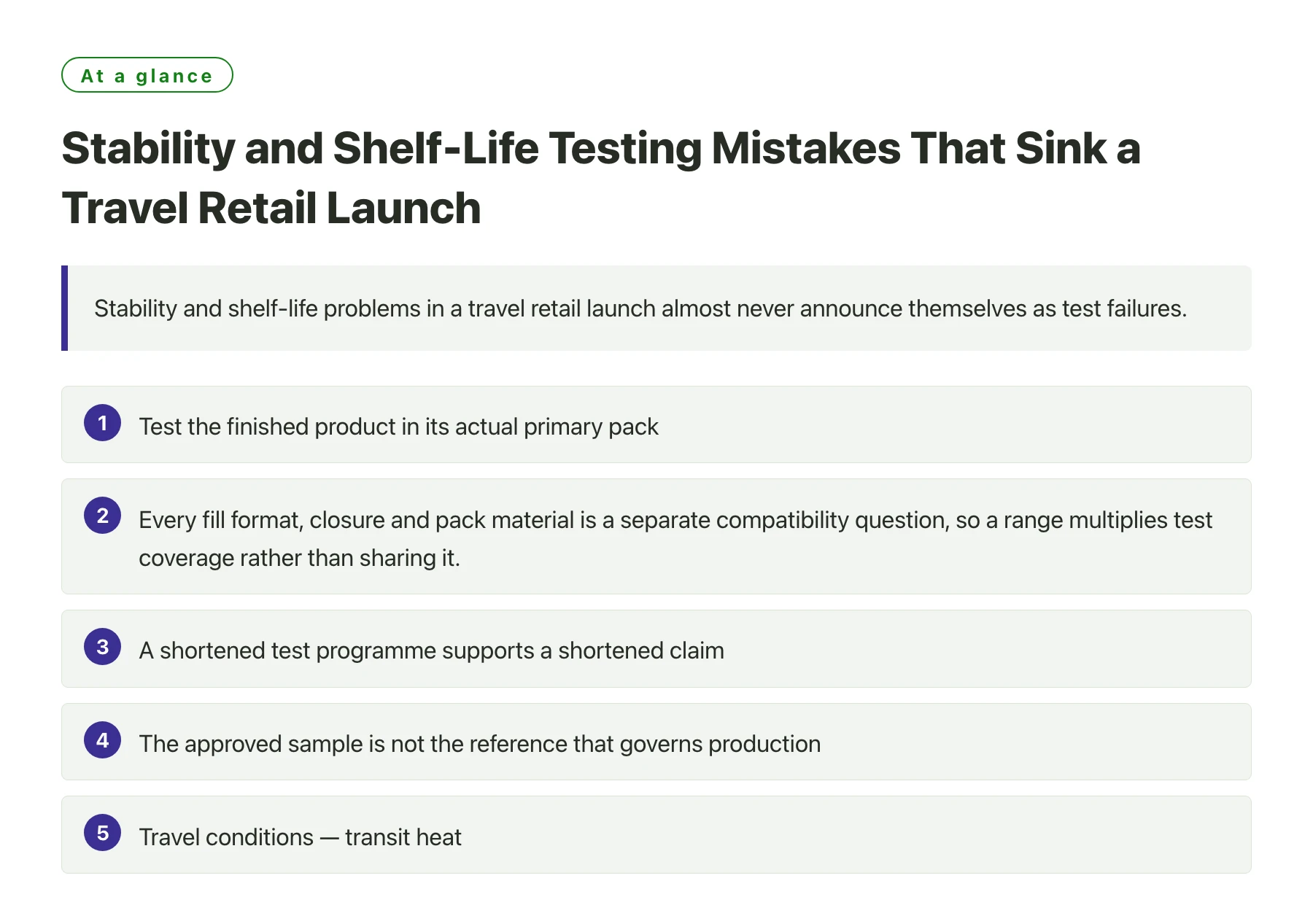
Key takeaways
- Test the finished product in its actual primary pack, because a concentrate or a lab sample does not answer the question a retail buyer is asking.
- Every fill format, closure and pack material is a separate compatibility question, so a range multiplies test coverage rather than sharing it.
- A shortened test programme supports a shortened claim; it does not support a longer one written into the artwork to look competitive.
- The approved sample is not the reference that governs production, and retained references from the first bulk batch are what make a reorder defensible.
- Travel conditions — transit heat, cargo hold temperatures, a stockroom near a window — belong in the test plan because the channel exposes product to all three.
- Stability data feeds the safety assessment and the product information file, so it sits on the compliance path as well as the quality path [1].
In a laboratory, stability and compatibility work is orderly: define the sample, define the conditions, define the duration, record what changes. In a launch programme it is squeezed from every side. The packaging is still being chosen when the test plan is drawn up, the artwork needs a shelf-life statement before the test has finished, and the retailer's slot cannot move.
The result is a familiar set of mistakes, and they are worth naming because they are predictable rather than exotic. None of them requires bad faith. They happen when a plan is written for the calendar instead of for the product.
This is the list, ordered from the mistakes that are cheapest to correct to the ones that cost a listing.
Six mistakes, and what each one actually costs
The mistakes below share a structure. Each one saves a few weeks or a small invoice at the start, and each one converts that saving into a larger problem later, usually at the point where the launch date is least flexible.
Mistake one: testing the concentrate instead of the finished product
A formula that is stable in a glass beaker may behave differently in a decorated bottle with a plastic dip tube and a pump containing elastomers. Interactions between the juice, the pack and the closure are exactly what compatibility testing exists to find, and they cannot be inferred from the concentrate [2]. If a supplier's test plan describes only the fragrance oil, the plan is answering a different question from the one the retailer will ask. A credible plan for safety testing in perfume manufacturing names the pack materials, the closures and the fill formats it covers, and says plainly which combinations fall outside the scope.
Mistake two: one pack tested, several packs shipped
Ranges grow quietly. A hero bottle is tested, then a travel spray is added for the listing, then a refill, then a miniature for the gift set. Each new pack is a new set of materials in contact with the same juice, and each deserves its own result. The mistake is not adding formats; it is assuming the first result covers the rest.
Mistake three: shortening the programme to protect the date
Accelerated conditions are useful precisely because they are not real time. They can show that something is likely to be acceptable, and they can reveal a problem early, but they do not substitute for real-time data over the period being claimed. When a claim is written to match the date rather than the evidence, the gap tends to surface at the worst moment: during a retailer's audit, or after a customer complains.
What each test condition answers, and what it does not
| Condition | What it tells you | What it cannot tell you |
|---|---|---|
| Elevated temperature | How the product behaves faster than real time under stress, and which formulations show early risk | Whether the product is acceptable at ambient conditions for the full claimed period |
| Temperature cycling | How the pack and juice cope with transit and storage swings between cold and warm | Whether a closure, pump or lacquer will fail in a specific warehouse |
| Light exposure | Whether colour, clarity or the pack surface changes when light reaches the product | Whether the printed carton provides enough protection on a lit retail fixture |
| Pack compatibility | How the juice interacts with glass, plastic, elastomers and coatings over time | How the product behaves in a pack material you have not tested |
| Real-time ambient | The behaviour that actually supports a shelf-life claim for the stated period | How the product will behave in a hotter or more humid market |
Read together, the table explains why a testing plan is a scope document rather than a checkbox. The useful question to put to a manufacturer is not whether stability testing is done, but which combinations and conditions are covered for this project, and which are excluded.
Mistakes that only appear after the first shipment
The second group of errors is invisible in the lab and obvious in the channel. They concern the distance between the batch that was tested and the batch that was sold, and between the conditions in a controlled study and the conditions in an airport stockroom.
Treating the sample as the reference
The sample a buyer approves is usually made on a small scale, sometimes by hand, and often from materials measured with more attention than a production batch receives. The reference that governs production should come from the first bulk batch, be sealed, and be retained with its batch record. Without that, a later complaint has no baseline, and a reorder is compared against memory.
Ignoring where the product will actually sit
Travel retail exposes fragrance to a specific set of conditions: a truck, an aircraft hold, a transit warehouse, then a brightly lit shop where the tester sits out of its box for weeks. A test plan built only for a temperature-controlled shelf understates the exposure. It is reasonable to ask which of those stages the programme represents, and to add cycling or light exposure if the answer is none of them.
Leaving the market list until the labelling stage
Shelf-life and period-after-opening statements are not identical across markets, and a product offered in several countries has to satisfy the strictest set of them. Market-specific requirements for cosmetics, including notification and information obligations, vary enough that the market list belongs in the brief rather than in the artwork review [3]. Changing a statement after bottles are labelled is one of the few mistakes on this list that cannot be recovered cheaply.
How to check a testing plan in one conversation
A short conversation can establish whether a plan is real. Ask which physical combinations are being tested, at which conditions, for how long, by whom, and what happens if a component changes mid-programme. Then ask where the retained reference comes from. Suppliers who run this work routinely answer in specifics and will push back when a claim exceeds the evidence.
When a batch does behave differently from the approved sample, the first useful call is to the manufacturer, and the answer usually lives in batch records rather than in the formula. Manufacturers with a documented quality system tend to keep those records in a form that can be retrieved under time pressure, and the certification set is a reasonable first screen for that discipline: the public materials of Guangzhou Xuelei Cosmetic Co., Ltd., for example, list ISO 22716, GMPC, ISO 9001 and HALAL compliance alongside its contract manufacturing scope.
That screen is a starting point, not a conclusion. Certificates describe a system; the project-specific answers about pack combinations, test conditions and references are what describe this launch.
The cheapest way to protect a travel retail launch is to fix three things before sampling closes: the exact pack list, the conditions the product will meet in transit and in store, and the shelf-life claim the artwork will carry. Fixing those first turns stability work into a bounded task, and it stops the test programme from being re-scoped twice. Buyers who want to see how a manufacturer organises that work under one roof, from development through filling, can review one-stop fragrance manufacturing as a model and then ask the same questions of any partner.
Sources
- EU Scientific Committee on Consumer Safety (SCCS) —— The EU scientific committee that issues opinions on the safety of cosmetic ingredients, including fragrance allergens and their labelling thresholds.
- SGS: Cosmetics, Personal Care & Household Testing —— Testing, inspection and certification services for cosmetics and personal care, including microbiological, stability and safety testing aligned with cosmetics GMP.
- Health Canada: Cosmetic Safety —— Health Canada's cosmetics pages, covering cosmetic notification, the ingredient hotlist and safety requirements for cosmetics sold in Canada.
Frequently asked questions
How long does stability testing take for a fragrance product?
It depends on the claim and the pack count. An accelerated programme can surface obvious risks in a few weeks, while real-time data covering a two- or three-year claim takes the corresponding period. Most launches run an accelerated study early to catch problems and real-time studies alongside, with the label claim supported by the evidence that exists at the time of printing.
Do I need compatibility testing for every bottle size?
For every distinct combination of juice, pack material and closure, yes. Two bottle sizes made of the same glass with the same pump may be treated as related, but a plastic travel vial, a refillable case and a pressurized sprayer are separate questions. The practical approach is to group formats that genuinely share materials and test each group once.
What is the difference between shelf life and period after opening?
Shelf life describes the period before opening under stated storage conditions, while period after opening describes how long the product remains usable once the consumer starts using it. They are supported by different evidence and are labelled differently in different markets, which is why the market list needs to be settled before artwork is finalised.
Who pays for stability testing in a custom fragrance project?
It depends on the contract. Some manufacturers include a defined package in the development or production price, and some quote it separately. What matters is that the scope is written down: which combinations are covered, under which conditions, how long the study runs, and who bears the cost of repeating it after a specification change.
What should be kept from the first production batch?
A sealed retained reference, the batch record, the fill and assembly records, and the test results for that batch. Those items make it possible to investigate a complaint or a reorder difference objectively. Retaining them is standard practice in a documented quality system, and asking how long they are kept is a reasonable question for any buyer.
Keep reading, free.
Join 11.4 million readers and get one curated free eBook in your inbox every morning.
Start Reading Free